)
)
How to Survive the Conference Buzzword Bingo
If you've been to a business show before, you know the game.
Walk the floor for half an hour, and your head is full of promises:
- AI will revolutionise your industry!
- Digital transformation is what every company need to do!
- Cloud adoption is the future!
Sounds exciting, right?
But for most SMEs, especially consulting and service firms running on Excel and goodwill, it can feel more like noise than opportunity. How do you distinguish between a buzzword and something that will genuinely help your business scale?
Let's break it down.
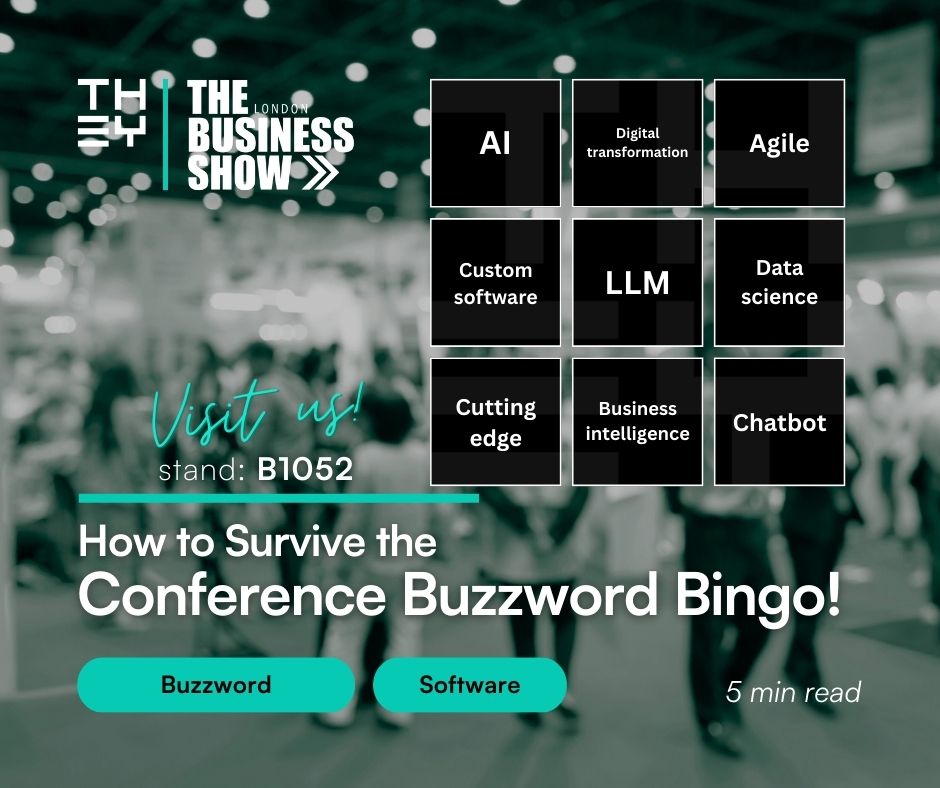
The Buzzword Bingo Card
Here are the usual suspects you'll hear shouted across the stands:
- AI — everything is "AI-powered" now. Even the coffee machine might claim machine learning.
- Digital Transformation — said so often, it's lost all meaning. Transformation into what, exactly?
- LLM — Large Language Models, often casually mentioned as if everyone in the room is a data scientist.
- No-Code / Low-Code — sometimes helpful, sometimes just a nice way of saying "you'll hit a wall later."
- Chatbots — if you want to annoy your clients before they reach a human, there's your tool.
- Custom Software — which can mean anything from a complete platform to a teenager freelancing in their bedroom.
- Cloud Adoption — as if moving Excel to Google Drive counts as a strategy.
- Tech alphabet soup — Java, JavaScript, C#, PostgreSQL, Kubernetes, GraphQL… impressive words, but not the answers to your problems.
You could add "blockchain," "metaverse," and "digital twin" if you want a full house.
Why Buzzwords Hook Us
Vendors use them because they work.
You hear "AI" and think of being more efficient. You hear "digital transformation" and picture your firm finally moving past messy spreadsheets. The words tap into real frustrations and desires.
But here's the catch: buzzwords are "the what", never "the how".
And it's the how that decides whether you waste money or solve a problem.
How to Spot Genuine Innovation
So, how do you cut through the jargon while standing at a stand with someone smiling at you over branded pens?
- Ask for context.
- If they mention "AI," ask: How would you specifically apply it to reduce the time my consultants spend on repetitive tasks? A serious provider will connect the buzzword to your business.
- If everything starts with a six-month "transformation project," be cautious. Good partners will discuss prototypes, proofs of concept, or audits that you can test before moving forward.
- Check for SME real-life case studies.
- Building for an enterprise bank is nothing like building for a 25-person consultancy. If they can't show examples with firms like yours, smile and move on.
- Do they explain things in plain English, or hide behind tech jargon? If you can't follow, your team won't either.
Red Flags to Run From
- Every sentence has three buzzwords but no examples.
- They avoid talking about costs or adoption.
- Their solution seems to require hiring a new IT department to run it.
The Final Thought
Conferences will always be full of buzzwords.
That's not the problem — the problem is when you mistake slogans for solutions.
The vendors worth your time will be the ones who:
- Ask about your processes, not just your project idea.
- Can demonstrate how a buzzword relates to a real SME problem.
- Start small, prove value, then scale.
So next time you hear "AI-powered digital transformation for the cloud", don't tick the bingo card. Ask how it actually helps your consultants serve more clients. That's the answer worth listening to.
Want to skip the buzzwords?
Visit TH-EY at stand B1052 and let's play a consulting game!
)