)
)
Is your AI ready for the EU AI Act?
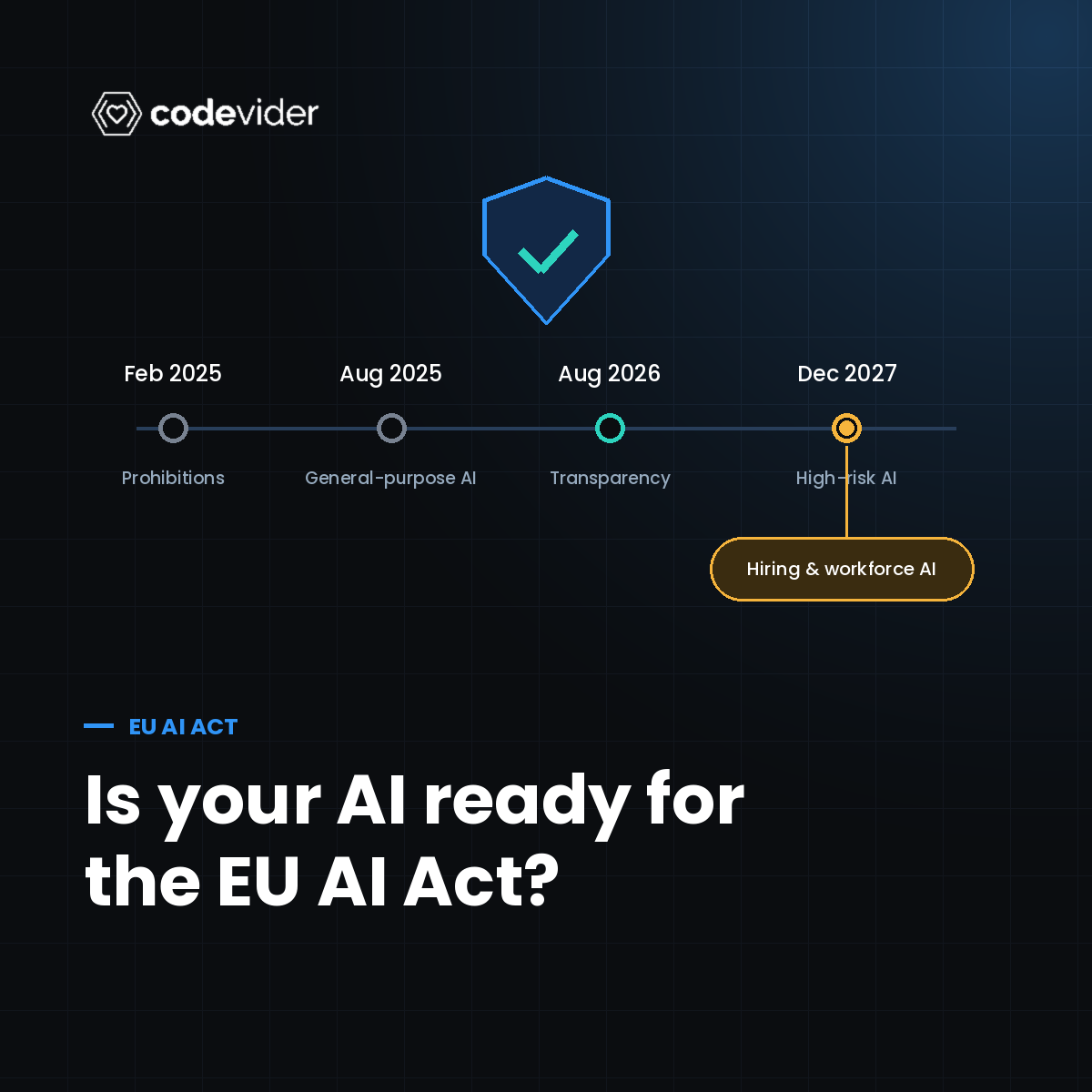
The EU AI Act is no longer a future problem. Its bans on unacceptable AI practices have applied since February 2025, the rules for general-purpose AI models since August 2025, and the transparency rules — telling people when they are talking to an AI, and marking AI-generated content — since August 2026.
The biggest set of rules, for high-risk AI, was due in August 2026. In July 2026 the EU’s Digital Omnibus moved that deadline to 2 December 2027. That is a deferral, not a cancellation — and for anyone building or buying high-risk AI, fifteen months is not long.
Does it apply to a UK business?
Often, yes. The Act applies to anyone who places an AI system on the EU market or whose AI output is used in the EU, wherever the company is based. A UK software company with EU customers, or a UK employer using AI on staff in EU offices, is in scope.
What counts as high-risk
The Act lists specific uses. One of them matters to almost every business: AI used in employment. That covers AI that screens or ranks job applicants, and AI that makes or supports decisions about workers — allocating tasks and shifts, monitoring or evaluating performance, promotion and termination.
If your workforce management, scheduling or HR software uses AI to make those decisions, it is likely high-risk.
What high-risk means in practice
For the company that builds the system:
- A risk-management process and documented testing
- Data governance for the data the model learns from
- Technical documentation and automatic logging of what the system does
- Human oversight built into the product, not bolted on
- Accuracy, robustness and cybersecurity requirements
- A conformity assessment and registration before it goes on the market
For the company that uses it:
- Using it as instructed, with trained people overseeing it
- Keeping the logs
- Informing workers and their representatives before an AI system that affects them goes live
Fines for breaching the high-risk rules reach €15 million or 3% of worldwide turnover.
How we help
We have built workforce management software since 2019 and we build AI agents today, so we see the Act from both sides — as engineers who have to implement it.
- AI inventory and classification. We map where AI is used in your products and processes, and which uses are likely high-risk.
- Gap assessment. A written report on what your system already does and what the Act will require it to do.
- Building compliance into the software. Audit logging, human-oversight workflows and approval gates, fairness and drift monitoring, worker notices, and the technical documentation that has to sit behind them.
- Keeping it compliant. Monitoring and documentation that keep up as the system changes.
We work alongside your legal advisers: they interpret the law, we make the software meet it.
Come to stand B1350 with a description of where you use AI, and we will tell you which parts of the Act are likely to touch it.
This article is general information, not legal advice.
)